 listicle
Private Money Lenders for Investors: 2026 Guide
Table of Contents
- What Private Money Lenders for Investors Actually Do
- Hard Money vs. Private Money: Key Differences
- Top Private Money Lenders for Investors in 2026
- Hard Money Loan Requirements You Need to Meet
- Equity-Based Lending for Distressed Properties
- The Private Money Loan Application Process Step by Step
- How to Vet a Lender and Plan Your Exit Strategy
- Conclusion
Last Updated: August 27, 2026
Finding the right private money lenders for investors can mean the difference between closing a deal in 48 hours and watching it collapse while a bank processes paperwork. At Bailout Capital, we work directly with distressed property owners and active real estate investors every day. Below, we break down exactly how private money lending works, who the top lenders are in 2026, and what separates a lender that saves your deal from one that just talks a good game.
Quick Picks:
- Best for Foreclosure Emergencies: Bailout Capital, equity-based, funds in 48-72 hours, no bank red tape
- Best for Fix-and-Flip Volume: Kiavi, simplified online platform, competitive rates
- Best for Loan Product Variety: Lima One Capital, fix-and-flip, rental, new construction, multifamily
- Best for Experienced Investors: Anchor Loans, flexible guidelines, loans up to $5 million
- Best for Low Credit Score Borrowers: Easy Street Capital, minimum 600 FICO for fix-and-flip
- Best for Asset-Based Qualification: Stratton Equities, no minimum FICO requirement
What Private Money Lenders for Investors Actually Do
Private money lenders are non-bank entities, individuals, funds, or private companies that provide short-term, asset-based loans secured by real property. Unlike conventional mortgage lenders, they evaluate deals primarily on the equity and value of the collateral, not the borrower's income history or credit profile.
The result: faster decisions, faster closings, and access to capital that traditional underwriting would deny. Private capital fills the gap between what banks will fund and what real estate investment demands, distressed acquisitions, foreclosure prevention, fix-and-flip projects, and bridge financing. Private money loans typically carry higher interest rates than conventional mortgages, shorter terms (commonly 6 to 24 months), and balloon payments at maturity.
Hard Money vs. Private Money: Key Differences
Most people use "hard money" and "private money" interchangeably, but the distinction matters when choosing a lender.
Hard money loans are asset-based loans issued by professional lending companies with standardized underwriting criteria, set origination fees, and defined loan-to-value thresholds. Private money loans can come from institutional sources or individual investors, family offices, or private networks lending on a deal-by-deal basis. Terms are often more negotiable, relationships matter more, and approval can be even faster, but variation in quality and reliability is greater.
| Feature | Hard Money | Private Money |
|---|---|---|
| Lender type | Professional company | Individual, fund, or company |
| Underwriting | Standardized, asset-based | Flexible, relationship-driven |
| Speed | 7-14 days typical | As fast as 24-72 hours |
| Rate negotiability | Limited | Often negotiable |
| Loan-to-value | Typically 65-80% | Varies widely |
| Best for | Fix-and-flip, bridge loans | Distressed situations, custom deals |
If you need capital fast and your situation doesn't fit a template, a private money lender with direct capital deployment is your fastest path. If you need a structured draw schedule for a renovation project, a hard money lender with formal construction management may serve you better.
Top Private Money Lenders for Investors in 2026
The lenders below represent a cross-section of what the private lending market offers in 2026. Each has a distinct strength, and choosing the wrong one for your situation costs time you may not have.

Bailout Capital: Best for Foreclosure Emergencies
When a foreclosure sale date is days away, most lenders can't move fast enough. Bailout Capital provides direct private money loans, bridge financing, and hard money options with funding in as little as 48-72 hours. The approach is equity-based: the focus is on the property's value and the borrower's equity position, not a credit score or income statement. Owner-occupants with destroyed credit, investors with past bankruptcies, and commercial property owners managing debt arrears can all access capital that a bank would never approve.
Best for: Property owners facing imminent foreclosure, BRRRR investors needing fast acquisition capital, and real estate investors with distressed rental properties.
Pros:
- Funding in 48-72 hours
- Equity-based qualification, credit history is not the deciding factor
- Direct private capital, no intermediaries
- Bridge financing for distressed properties
Kiavi: Best for Fix-and-Flip Volume
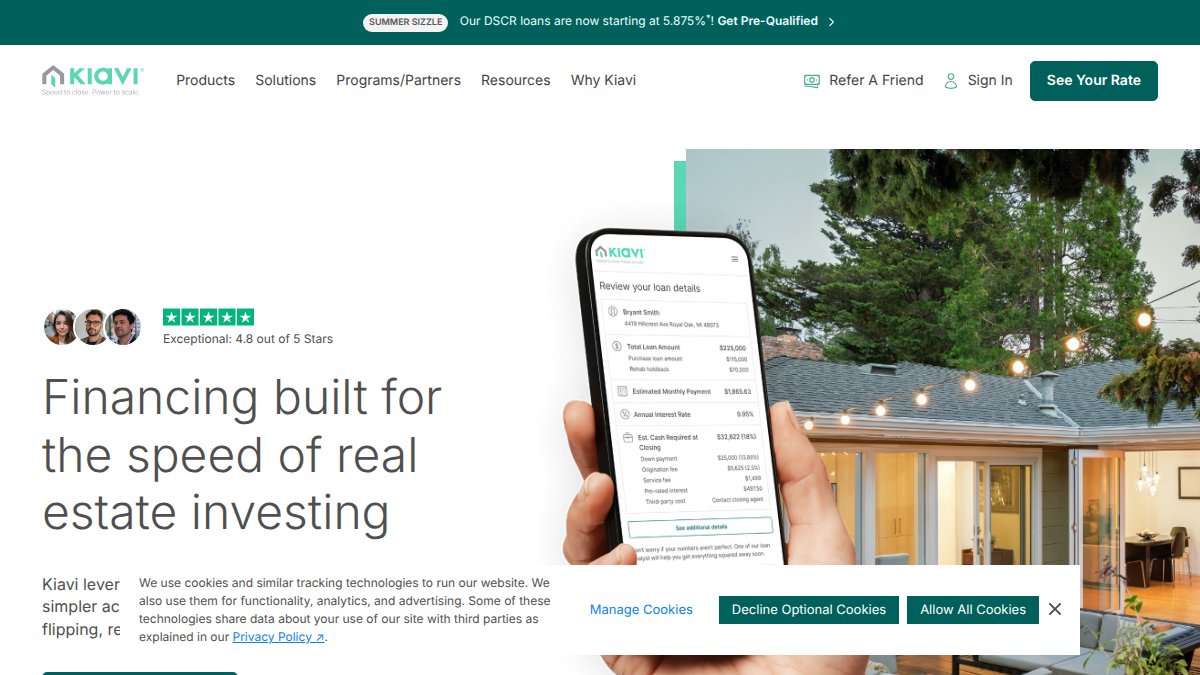
Kiavi has built one of the most simplified online lending platforms in the private money space. Fix-and-flip and bridge loans are available with terms of 12, 18, or 24 months. Kiavi requires no application fee, no appraisal for fix-and-flip loans, and no income verification, a meaningful advantage for investors whose tax returns don't reflect their actual deal activity (kiavi.com). The platform lends in 32 states and Washington D.C.
Pros:
- Fast closing, often 7-10 business days
- Up to 95% LTC for purchase, 100% of rehab costs covered
- Soft credit pull for pre-qualification
- No appraisal required for fix-and-flip loans
Lima One Capital: Best for Loan Product Variety
Lima One Capital offers breadth across multiple strategies. The product suite covers fix-and-flip, rental, new construction, multifamily, and bridge loans in 46 states plus Washington D.C.. In-house servicing handles underwriting, appraisals, construction management, and loan servicing, which keeps the process consistent.
Pros:
- Comprehensive product suite for diverse investment needs
- National footprint across most of the country
- In-house team reduces third-party delays
Anchor Loans: Best for Experienced Investors
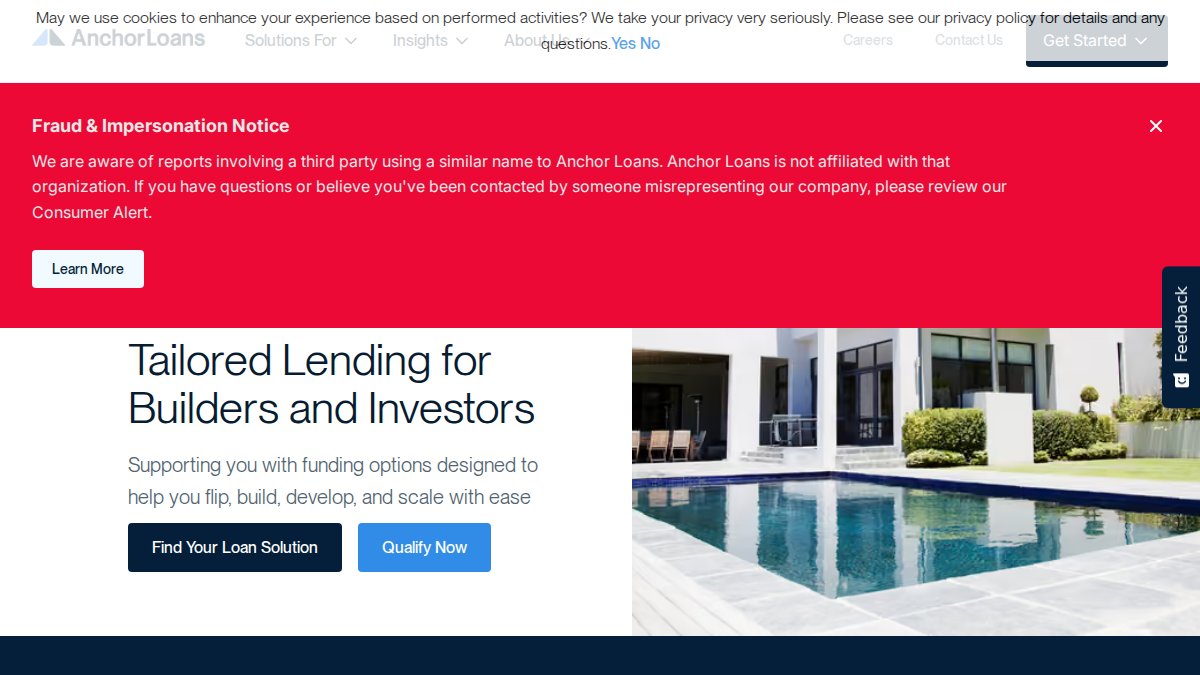
Anchor Loans targets experienced residential investors and builders with loan amounts from $50,000 to $5,000,000, covering fix-and-flip, new construction, and single-family rental via DSCR loans up to 80% LTV (anchorloans.com). Some loans close in as few as two days.
Pros:
- Fast approval and funding, sometimes within 2 days
- Flexible guidelines and customized loan programs
- High loan ceiling at $5 million
Easy Street Capital: Best for Low Credit Score Borrowers
Easy Street Capital addresses the biggest barrier most distressed borrowers face: the credit floor. The EasyFix product accepts a minimum 600 credit score for fix-and-flip loans (easystreetcapital.com). Applications receive a term sheet within 24 hours, and funding can happen in as little as 48 hours. The product range covers fix-and-flip, rental, home renovation, multifamily, mixed-use, ground-up construction, and bridge loans.
Pros:
- Lowest minimum credit score requirements among major private lenders
- Extremely fast approval and funding timelines
- No appraisal required for some loan types
Stratton Equities: Best for Asset-Based Qualification
Stratton Equities takes asset-based lending to its logical conclusion: no minimum FICO requirement for hard money loans. The underwriting focus is entirely on property value and equity position. Stratton lends on both commercial and residential investment properties nationwide, with an average closing time of 14 days.

Pros:
- No minimum FICO requirement
- Nationwide lending for various property types
- Focus on property value enables more flexible qualification
Hard Money Loan Requirements You Need to Meet
Hard money loan requirements center on the property and the deal structure, not the borrower's financial biography. The core requirement across virtually every private and hard money lender is loan-to-value ratio. Most lenders cap at 65-80% LTV on the as-is value. For fix-and-flip deals, lenders often use loan-to-cost and loan-to-after-repair-value metrics instead.
Beyond LTV, common requirements include:
- Equity position: Sufficient equity in the subject property to collateralize the loan
- Exit strategy: A clear, credible plan for repayment, sale, refinance, or rental income
- Promissory note: A signed legal commitment to repay under the agreed terms
- Lien position: Most private lenders require first lien position on the collateral
- Property condition assessment: Some form of evaluation, ranging from a full appraisal to a broker price opinion
- Entity documentation: Many lenders require borrowing through an LLC or corporation for investment properties
- Debt service coverage ratio (DSCR): For rental loans, lenders assess whether rental income covers the debt obligation
Equity-Based Lending for Distressed Properties
Equity-based lending for distressed properties operates on a simple premise: if there is recoverable value in the collateral, the loan can be made. A distressed property is one where deferred maintenance, financial hardship, or market conditions have reduced its marketability, but not necessarily its underlying value. A lender evaluating equity position looks at the gap between the current property value and the total debt secured against it. If that gap is meaningful, there is collateral to lend against.

For investors using the BRRRR strategy, Buy, Rehab, Rent, Refinance, Repeat, equity-based bridge financing is the mechanism that makes the acquisition phase possible before conventional refinancing becomes available. Key considerations include as-is value versus after-repair value metrics, lien position confirmation, title issues, and closing costs that factor into total capital requirements.
The Private Money Loan Application Process Step by Step
The private money loan application process is faster than conventional mortgage lending, but it still has defined stages. Knowing each one prevents delays that cost deals.
Step 1: Identify your collateral and equity position Before contacting any lender, know your property's estimated current value and the total debt secured against it. This determines your LTV and whether a private loan is feasible.
Step 2: Define your exit strategy Every private lender will ask how you plan to repay the loan. Sale, cash-out refinance, or DSCR rental loan are the three most common exits. Have a specific, realistic answer before your first conversation.
Step 3: Request term sheets from 2-3 lenders Contact multiple lenders simultaneously. Request term sheets, not full applications, so you can compare rate, origination fee, LTV, and closing timeline side by side.
Step 4: Select a lender and submit a full application Once you've chosen a lender, submit the required documentation. For most private lenders, this includes a property description, purchase contract or existing mortgage statement, and entity documentation if borrowing through an LLC.
Step 5: Property evaluation The lender orders a valuation, full appraisal, desktop appraisal, or broker price opinion depending on their process. Ask the lender upfront how long it takes.
Step 6: Underwriting and approval The lender reviews the deal against their LTV limits, lien position requirements, and exit strategy viability. For equity-based lenders, this step moves faster than conventional underwriting.
Step 7: Closing and funding A promissory note and deed of trust are executed. Funds are disbursed. For emergency situations, lenders like Bailout Capital can compress steps 3 through 7 into 48-72 hours.
| Step | Action | Typical Duration |
|---|---|---|
| 1 | Assess equity and collateral | 1 day |
| 2 | Define exit strategy | 1 day |
| 3 | Collect term sheets | 1-2 days |
| 4 | Submit full application | 1 day |
| 5 | Property evaluation | 2-7 days |
| 6 | Underwriting and approval | 1-3 days |
| 7 | Closing and funding | 1-2 days |
How to Vet a Lender and Plan Your Exit Strategy
The private lending market is less regulated than conventional mortgage lending. Business-purpose loans secured by investment properties are generally exempt from many consumer protection rules that apply to owner-occupied mortgages. That regulatory gap means the due diligence burden falls on you.
Vetting a lender's track record:
- Ask for references from borrowers on closed deals, not website testimonials
- Verify the lender's license status through your state's Department of Financial Institutions
- Search the lender's name and principals in your state's court records for litigation history
- Confirm the lender uses a licensed title company and standard closing documents
Red flags to walk away from:
- Upfront fees before a term sheet is issued
- Vague or verbal commitments on rate and timeline
- Pressure to close without reviewing documents
- No verifiable track record of closed deals
- Requests to transfer title as a condition of the loan
Exit strategy planning:
A balloon payment at the end of a 12-month hard money loan is not a problem if your exit is solid. It becomes a crisis if the exit fails. Plan for two scenarios: your primary exit and a backup. For fix-and-flip investors, the primary exit is sale; the backup is a DSCR rental loan if the property doesn't sell within the loan term. For foreclosure prevention, the primary exit is stabilization and refinance into a conventional or non-QM loan; the backup is a controlled sale before the loan matures.
Lender Comparison at a Glance
| Lender | Best For | Min. Credit Score | Closing Speed | Loan Range |
|---|---|---|---|---|
| Bailout Capital | Foreclosure emergencies | Equity-based | 48-72 hours | Contact for details |
| Kiavi | Fix-and-flip volume | Not specified | 7-10 business days | $100K to $5M |
| Lima One Capital | Loan product variety | Not specified | 7-10 business days | Varies by product |
| Anchor Loans | Experienced investors | 650 preferred | As fast as 2 days | $50K-$5M |
| Easy Street Capital | Low credit borrowers | 600 (fix-and-flip) | 48 hours | $75K to $5M+ |
| Stratton Equities | Asset-based qualification | None required | ~14 days | $100K to $5M |
Distressed property owners and active investors face the same core problem: conventional lenders move too slowly and disqualify too many borrowers to be useful in a crisis. Bailout Capital was built to solve that problem directly, equity-based lending, direct private capital, and funding in as little as 48-72 hours mean you can stop a foreclosure or close a time-sensitive acquisition without waiting for a bank that may never say yes. If your situation is urgent, contact Bailout Capital today and get a direct answer on what your equity can do.
=== FAQ ANSWERS (audit these too, same rules) ===
[1] Q: What is the difference between a hard money lender and a private money lender? A: Hard money lenders are typically companies that lend against real estate collateral at higher interest rates with short terms, using a formal underwriting process. Private money lenders can be individuals or firms that operate more informally, often with more flexible terms. In practice, the two overlap significantly: most hard money lenders are private lenders, but not every private lender operates as a hard money shop. Both focus on asset-based lending rather than borrower creditworthiness.
[2] Q: Do private money lenders require a credit check? A: Most private money lenders do pull credit, but a low score rarely disqualifies you outright. Lenders like Stratton Equities advertise no minimum FICO requirement for hard money loans. Others, such as Easy Street Capital, accept scores as low as 600. The primary qualification factor is the property's loan-to-value ratio and the equity available, not your credit history. A bankruptcy or missed payments matters far less to a private lender than it does to a conventional bank.
[3] Q: How quickly can private money lenders fund a real estate deal? A: Funding speed varies by lender and deal complexity. Some lenders, including Easy Street Capital and Anchor Loans, advertise closings in as few as 48 hours to 2 days for straightforward deals. Kiavi and Lima One Capital typically close in 7-10 business days. The fastest timelines apply when title is clear, the property has strong equity, and your documentation is ready. Complex deals, title issues, or properties in certain states can extend the timeline.
[4] Q: What collateral is required for private money loans? A: The investment property itself serves as the primary collateral for private money loans. Lenders record a lien against the property, typically in first position, and size the loan based on the loan-to-value ratio. Most lenders cap loans at 70-80% of the property's current value or after-repair value. Some lenders require a promissory note and a deed of trust or mortgage. Additional collateral such as other real estate assets may be requested for larger or higher-risk loans.
[5] Q: What are the typical interest rates for private money loans? A: Rates vary by lender, loan type, and borrower profile. Based on publicly available lender data, fix-and-flip loan rates range from roughly 7.75% to 13% annually, with origination fees typically between 1% and 5% of the loan amount. Bridge loans and distressed-property loans often sit at the higher end of that range. Rates change with market conditions, so contact lenders directly for current pricing. Factor in origination fees, closing costs, and any balloon payment when calculating your true cost of capital.
Frequently Asked Questions
Q: What is the difference between a hard money lender and a private money lender?
A: Hard money lenders are typically companies that lend against real estate collateral at higher interest rates with short terms, using a formal underwriting process. Private money lenders can be individuals or firms that operate more informally, often with more flexible terms. In practice, the two overlap significantly: most hard money lenders are private lenders, but not every private lender operates as a hard money shop. Both focus on asset-based lending rather than borrower creditworthiness.
Q: Do private money lenders require a credit check?
A: Most private money lenders do pull credit, but a low score rarely disqualifies you outright. Lenders like Stratton Equities advertise no minimum FICO requirement for hard money loans. Others, such as Easy Street Capital, accept scores as low as 600. The primary qualification factor is the property's loan-to-value ratio and the equity available, not your credit history. A bankruptcy or missed payments matters far less to a private lender than it does to a conventional bank.
Q: How quickly can private money lenders fund a real estate deal?
A: Funding speed varies by lender and deal complexity. Some lenders, including Easy Street Capital and Anchor Loans, advertise closings in as few as 48 hours to 2 days for straightforward deals. Kiavi and Lima One Capital typically close in 7-10 business days. The fastest timelines apply when title is clear, the property has strong equity, and your documentation is ready. Complex deals, title issues, or properties in certain states can extend the timeline.
Q: What collateral is required for private money loans?
A: The investment property itself serves as the primary collateral for private money loans. Lenders record a lien against the property, typically in first position, and size the loan based on the loan-to-value ratio. Most lenders cap loans at 70-80% of the property's current value or after-repair value. Some lenders require a promissory note and a deed of trust or mortgage. Additional collateral such as other real estate assets may be requested for larger or higher-risk loans.
Q: What are the typical interest rates for private money loans?
A: Rates vary by lender, loan type, and borrower profile. Based on publicly available lender data, fix-and-flip loan rates range from roughly 7.75% to 13% annually, with origination fees typically between 1% and 5% of the loan amount. Bridge loans and distressed-property loans often sit at the higher end of that range. Rates change with market conditions, so contact lenders directly for current pricing. Factor in origination fees, closing costs, and any balloon payment when calculating your true cost of capital.
This article was written using GrandRanker