 how-to
Emergency Financing for Commercial Property: Fast Access to Capital
Table of Contents
- What Emergency Financing for Commercial Property Looks Like
- Types of Emergency Commercial Real Estate Loans
- How Rapid Underwriting Works When Time Matters
- Commercial Real Estate Bridge Loan Requirements
- The Cost of Speed: Interest Rates, Fees, and True Total Cost
- Emergency Liquidity vs. Long-Term Capital Strategy
- Stabilizing Your Property After Emergency Funding
- Frequently Asked Questions
Last Updated: September 20, 2026
What Emergency Financing for Commercial Property Looks Like
When commercial property owners face unexpected crises, missed payments, sudden capital needs, or time-sensitive deals, traditional bank financing is too slow. Emergency financing for commercial property delivers capital in days instead of weeks or months.
Property owners dealing with foreclosure threats, renovation emergencies, or time-sensitive acquisitions need access to cash when conventional lenders say no. Rapid, equity-based solutions step in.
Emergency financing for commercial property works through private lenders who prioritize speed over credit scores, focusing on property value and equity stake rather than income history. This cuts underwriting from 30-45 days to 48-72 hours.
The trade-off is straightforward: faster access costs more in interest and fees. But when the alternative is losing the property or missing a critical opportunity, that cost becomes manageable.
Types of Emergency Commercial Real Estate Loans
Commercial property owners facing urgent capital needs have several options. Each serves different situations and comes with distinct timelines and costs.
Bridge Financing for Commercial Real Estate
Bridge financing for commercial real estate fills the gap between immediate capital needs and long-term solutions, designed for owners who need funds now but plan to refinance, sell, or secure permanent financing later.
Bridge loans typically last 6-24 months and cover missed mortgage payments, emergency repairs, or distressed property acquisitions before renovation and resale.
The main advantage is speed: lenders approve bridge financing in days because they lend against property equity, not creditworthiness.
Common bridge loan uses:
- Stopping foreclosure while refinancing
- Funding emergency property repairs
- Acquiring properties at auction with tight closing timelines
- Covering operational costs during property transitions
Hard Money Loans
Hard money loans are short-term loans backed by real estate collateral. Private lenders fund these loans using investor capital rather than bank deposits. This means faster decisions and less red tape.
Hard money lenders evaluate property value and borrower equity, ignoring traditional credit metrics. They lend when banks won't, even to borrowers with bankruptcy, missed payments, or poor credit.
Hard money loans typically run 12-36 months with interest-only payments during the term and principal repayment at maturity.
Hard money works best for:
- Investors buying distressed properties
- Property owners with damaged credit needing fast capital
- Renovation projects requiring quick funding
- Short-term bridge solutions before refinancing
Private Money Lenders for Investors
Private money lenders for investors are individuals or small groups who lend their own capital, making faster decisions and customizing terms compared to institutional lenders.
These lenders often specialize in specific property types or investor profiles, including rental properties, fix-and-flip projects, and BRRRR strategy investors (Buy, Rehab, Rent, Refinance, Repeat).
Private money lenders for investors typically require:
- 20-30% equity in the property
- Clear exit strategy (refinance, sale, or rental income)
- Property appraisal or recent purchase documentation
- Basic financial information
The advantage is flexibility. Private lenders negotiate terms directly with borrowers. If you're a serious investor with a solid property, private money lenders for investors often approve deals banks reject.
How Rapid Underwriting Works When Time Matters
When speed matters, lenders use simplified underwriting that compresses traditional timelines from 30-45 days to 48-72 hours for approval and 5-15 days for full funding. Emergency financing for commercial property achieves this through desktop BPO and automated risk assessment.
Traditional bank underwriting involves multiple departments (credit analysis, appraisal, title review, legal review, loan committee approval), each adding days. Emergency lenders collapse this into a single-decision model: property equity analysis.
The Core Underwriting Criteria for Speed
-
Loan-to-Value (LTV) Ratio, The primary decision driver. If your property is worth $500,000 and you owe $300,000, your equity is $200,000 (40% LTV). Lenders approve loans up to 65-75% LTV almost automatically because the equity cushion covers their risk. Loans above 80% LTV require additional scrutiny and slow the process.
-
Property Valuation Method, A Broker Price Opinion (BPO) takes 24-48 hours; a full appraisal takes 7-14 days; an automated valuation model (AVM) takes hours. Lenders offering 48-72 hour approvals use BPOs or AVMs. Providing a recent appraisal or purchase agreement accelerates approval further.
-
Title and Lien Verification, A title report (24-48 hours) confirms ownership and identifies liens. Clear titles or standard mortgages move forward quickly; tax liens, judgment liens, or HOA liens add 3-5 days for position evaluation.
Timeline Breakdown for Different Approval Speeds
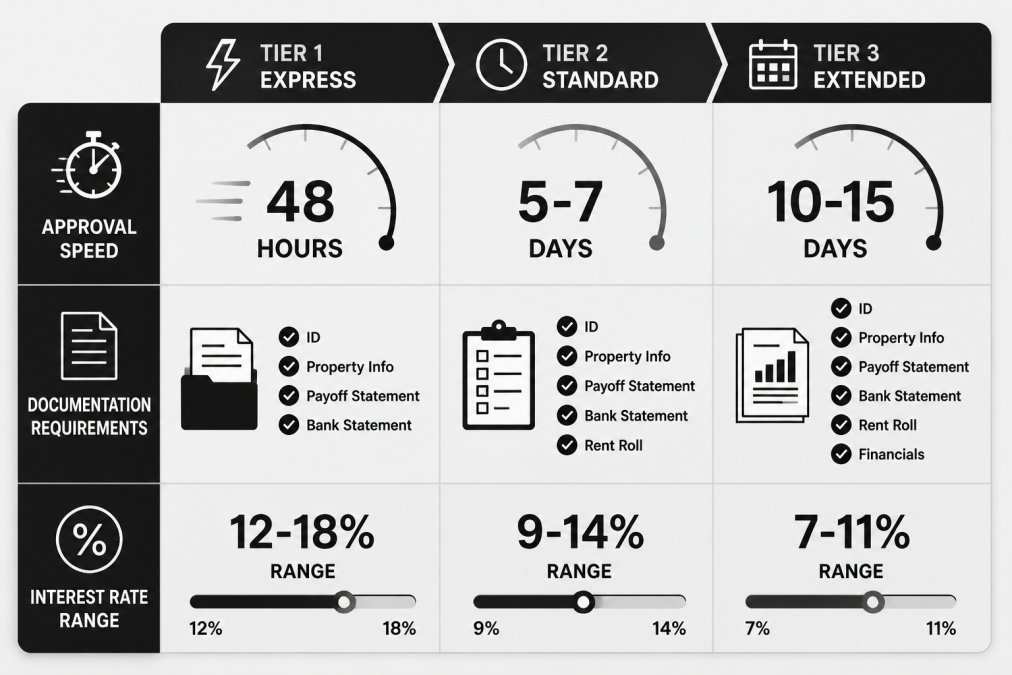
Fastest (48-72 hour approval): Provide property address, value estimate, and existing debt. Lender orders BPO and title simultaneously. If LTV is under 70% and title is clear, funding within 1-3 business days.
Standard (5-7 day approval): Provide appraisal, title report, and financial information. Lender verifies equity and property condition. Funding within 5-10 business days.
Slower (10-15 day approval): Property requires full appraisal, liens require negotiation, or complex ownership structure exists. Funding within 10-21 business days.
Documentation That Speeds Approval
Having these documents ready before you apply cuts 3-5 days off the timeline:
- Recent appraisal or BPO (within 90 days), Eliminates the lender's need to order one
- Current title report, Shows ownership and existing liens; if you ordered this for another purpose, provide it
- Proof of property value, Recent purchase agreement, tax assessment, or comparable sales data
- Existing mortgage statement, Shows current balance and lender information
- Personal financial statement, Assets, liabilities, income; even if credit is poor, this shows you have reserves
- Property insurance declaration, Proves the property is insurable and you maintain coverage
What Slows Emergency Underwriting
These situations add 5-10 days: multiple liens or title issues requiring payoff verification; recent foreclosure or bankruptcy requiring legal standing verification; commercial property with tenants requiring lease agreements and rent rolls; property in poor condition requiring inspection; or unusual ownership structures (LLCs, trusts, corporate) requiring legal review.
The Speed-vs.-Cost Trade-off
Lenders offering rapid approvals may charge higher interest due to faster decisions with less information. Lenders offering approvals over a longer timeframe may charge lower rates because they have more time to verify details. Waiting longer for approval may result in savings on the interest rate.
Commercial Real Estate Bridge Loan Requirements
Bridge financing for commercial real estate requires less documentation than traditional mortgages. Typical requirements: property appraisal (often a BPO), current title report, proof of ownership, personal financial statement, loan purpose explanation, and exit strategy. Some lenders also request recent tax returns, bank statements, proof of insurance, and lease agreements if applicable.
The property is the primary security. Lenders focus on loan-to-value (LTV) ratio and will lend up to 65-75% of current property value. Your credit score matters less than your equity; borrowers with credit scores below 600 can qualify for bridge financing for commercial real estate if the property has sufficient equity.
The Cost of Speed: Interest Rates, Fees, and True Total Cost
Emergency financing for commercial property costs more than traditional mortgages, but the real question is: compared to what? Foreclosure? A bank loan you can't get in time? Losing a deal? This section breaks down actual costs and shows when emergency financing makes financial sense.
Interest Rates: The Primary Cost Driver
Upfront Fees: The Hidden Costs
Total Cost Calculation: Emergency Financing vs. The Alternative
The Cost-Benefit Analysis
When Emergency Financing Makes Financial Sense
When Emergency Financing Is a Mistake
Comparing Rates Across Lender Types
Negotiating Rates and Fees
Emergency Liquidity vs. Long-Term Capital Strategy
Emergency financing and long-term capital serve different purposes. Confusing them creates problems.
Stabilizing Your Property After Emergency Funding
Once you've secured emergency financing for commercial property, stabilize the property to refinance, sell, or move to permanent financing. Stabilization varies: for foreclosure prevention, catch up on missed payments and refinance before the bridge loan matures; for renovations, fund repairs and refinance based on improved value; for acquisitions, close the deal and refinance into permanent financing; for rentals, cover vacancy periods and refinance once cash flow stabilizes.
Frequently Asked Questions
What's the fastest way to get emergency financing for commercial property?
Bridge financing and hard money loans are the fastest options, often closing in 48-72 hours. Unlike traditional banks, private money lenders for investors use equity-based underwriting rather than credit scores. They focus on the property's value and your equity position, not your financial history. This streamlined approach eliminates weeks of documentation review, making it ideal when foreclosure is imminent or you need capital quickly for property acquisition.
Can I qualify for emergency commercial real estate bridge loan requirements with poor credit or a past bankruptcy?
Yes. Bridge financing for commercial real estate prioritizes the property's equity and your ability to service the loan, not your credit score. Private lenders evaluate the collateral first. Past bankruptcies or low credit are not automatic disqualifiers. However, you'll need sufficient equity in the property and clear documentation of your current financial position. Lenders will verify your ability to repay based on the property's cash flow or your exit strategy, not historical credit events.
How much will emergency financing for commercial property actually cost me?
Pricing depends on loan amount, property type, equity position, and loan term. Interest rates and fees vary by lender and risk profile. Rather than guessing a figure, contact a lender directly for a quote based on your specific situation. Understanding the total cost includes interest, origination fees, and any other charges, not just the headline rate. Compare total cost across options before committing, especially if you're using this as a bridge to a longer-term solution.
What if my commercial property is already in default or foreclosure, can I still get emergency financing?
Yes, but speed becomes critical. Lenders can still work with properties in default if you have sufficient equity and a clear exit strategy. Some specialize in this exact scenario. The key is demonstrating that the loan amount won't exceed your equity cushion and that you have a plan to stabilize or sell the property. The closer you are to foreclosure, the more important it is to contact a lender immediately, waiting reduces your options and increases costs.
Emergency financing for commercial property exists to solve urgent problems, foreclosure, emergency repairs, time-sensitive deals. But speed comes with cost. Bailout Capital provides fast capital when traditional lenders won't, cutting underwriting timelines to 48-72 hours and funding within days. The real win is having a clear exit strategy before you borrow. Get the capital you need to stop the crisis, then execute a plan to move to permanent financing or achieve your property goals.